
Construction
Current & Future Construction Phases
Construction of prep and preservation work on the I-5 Rose Quarter Improvement Project began in summer 2025.
Read below for more information about current and future construction phases.
For information about active and future travel impacts, visit our Construction Travel Impacts page.
Prep & Preservation
Click here to view a larger version of this graphic
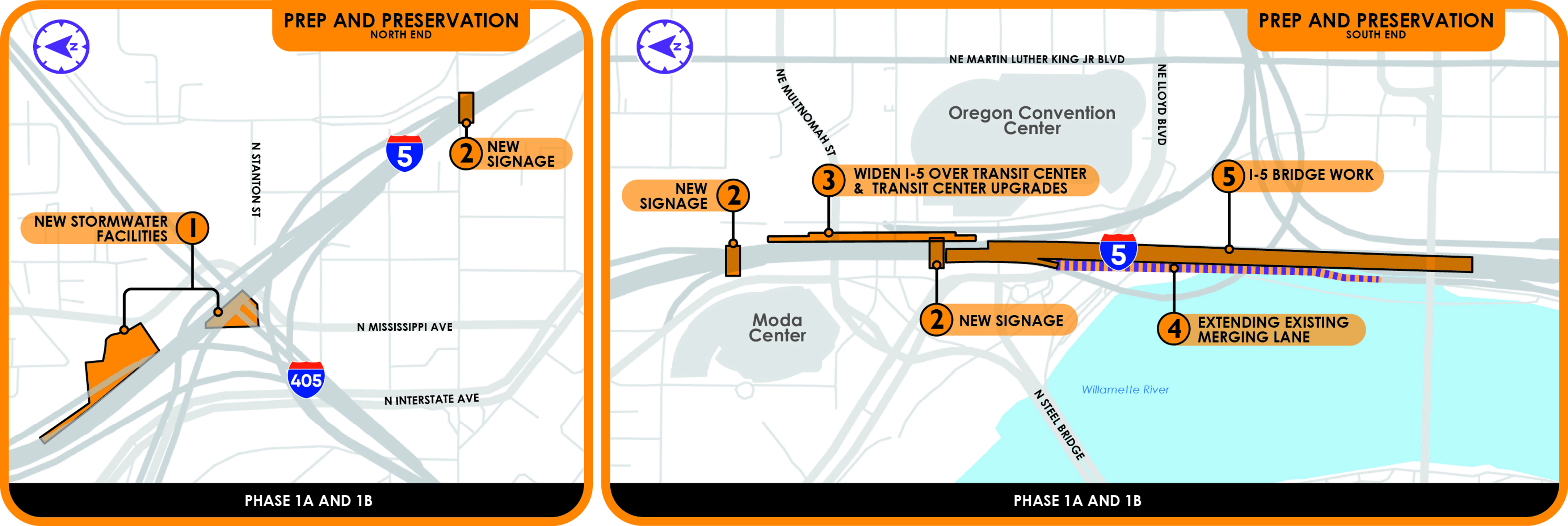
Rose Quarter Prep and Preservation (Phase 1A and 1B) summer 2025 – 2029
Construction Cost: $242.5 million
Traffic Impacts: Visit the Construction Travel Impacts page to learn more.
Components Under Construction - Associated Benefits
Challenge
1. Stormwater Improvements
Improvement
- Improves Willamette River water quality.
Challenge
2. New signage

Improvement
- Provides new directional signs to assist travelers with navigation.
Challenge
3. I-5 repair work near the intersection of I-84, including concrete surface replacement, structural repairs, safety improvements, and earthquake readiness upgrades

Improvement
- Preserves I-5 for the future and avoids disruptive, ongoing and costly emergency repairs.
- Updates I-5 with new barriers and rails to meet modern safety standards.
- Strengthens I-5 structure and replaces the current rutted, cracked and potholed surface for long-term preservation.
- Implements earthquake safety improvements to create a more resilient I-5.
Challenge
4. Extension of the southbound merging lane along I-5 between the I-84 and Morrison Bridge/OMSI exits
Improvement
- Builds the southern portion of the southbound auxiliary lane between I-84 and the Morrison Bridge exit, creating more time and space for changing lanes.
Challenge
5. Widen I-5 structure over Rose Quarter Transit Center to increase shoulder width on I-5 and reconstruct impacted transit center infrastructure
Improvement
- Improves safety by adding wider shoulders for emergency services and disabled vehicles to move out of traffic.
- Creates space for future construction of the northbound and southbound merging lanes.
- Upgrades sidewalks and curb ramps at the Rose Quarter Transit Center for improved access and ADA compliance.
- Improves lighting in the transit center to meet modern standards.
- Incorporates architectural features to honor the Rose Quarter and historic Albina neighborhood.
- Integrates existing light rail facilities with new overhead structure.
Challenge
Begin right-of-way acquisition for future project construction

Improvement
- Prepares the project area for construction of the highway cover.
Workforce Benefits:
- Creates an estimated 225,000 craft labor hours with more than $23 million in craft payroll and benefits.
- Builds capacity and creates mentorship opportunities for small businesses to gain experience.
Phase 1C
Click here to view a larger version of this graphic
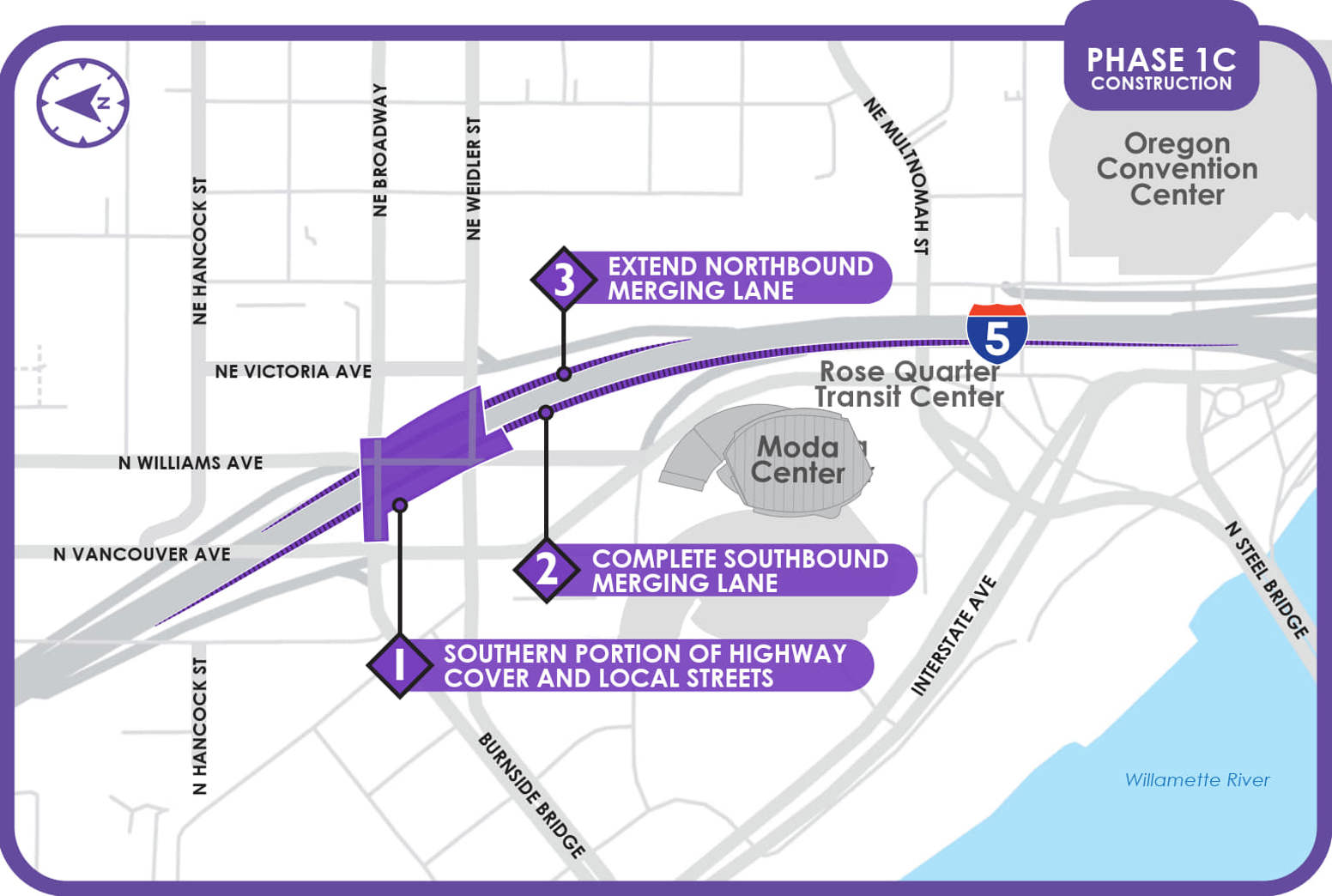
Phase 1C construction to begin in 2029 dependent on additional funding for final design and construction
Cost: $940 million to $1 billion
Construction Components - Associated benefits
Challenge
1. Completion of the southern portion of the highway cover from Broadway to south of Weidler (approximately 30% of total cover length), along with local street reconstruction on Broadway, Williams, and Weidler
Improvement
- Delivers substantial development on the highway cover
- Reconnects the Historic Albina Neighborhood with the first portion of the highway cover and new local street improvements
Challenge
2. Completion of the I-5 southbound merging lane from I-405 to I-84
3. Extension of the northbound merging lane and shoulders to Broadway
Improvement
- Modernizes and improves the highway design with longer merge areas and wider shoulders
- Reduces crashes and makes travel time more reliable for freight carriers, commuters and first responders by creating safer conditions and providing more space for vehicles to merge
Why Phase 1C?
- Continuing construction with Phase 1C maintains construction momentum, keeps living-wage construction jobs at work, and minimizes the costs associated with stopping and restarting work.
- The three components of Phase 1C, are the most logical, most efficient and minimum viable next phase for the Rose Quarter project.
- Currently, the supports for the Broadway, Weidler, and Williams bridges conflict with where the new I-5 northbound and southbound merging lanes will be. In order to build the new merging lanes, the three bridges and their supports must be removed and replaced. These bridges all sit on the same supports, meaning that their foundations are intertwined and need to be removed at the same time. Therefore, all three bridges must be replaced together with the new cover to support the local street network.
- This approach to constructing the merging lanes and the cover together also provides the necessary space to maintain traffic flow on I-5 while the new cover is constructed. Any other approach would reduce the number of travel lanes for multiple years and make the traffic bottleneck in this area even worse.
- Completing these three elements together minimizes temporary work and avoids constructing elements that would need to be torn out to construct future phases.
- Completion of these three elements provides independent utility, offering tangible benefits for safety, mobility, and community reconnection even before the full project is completed. Phase 1C also lays the groundwork for future phases.
Future Phases
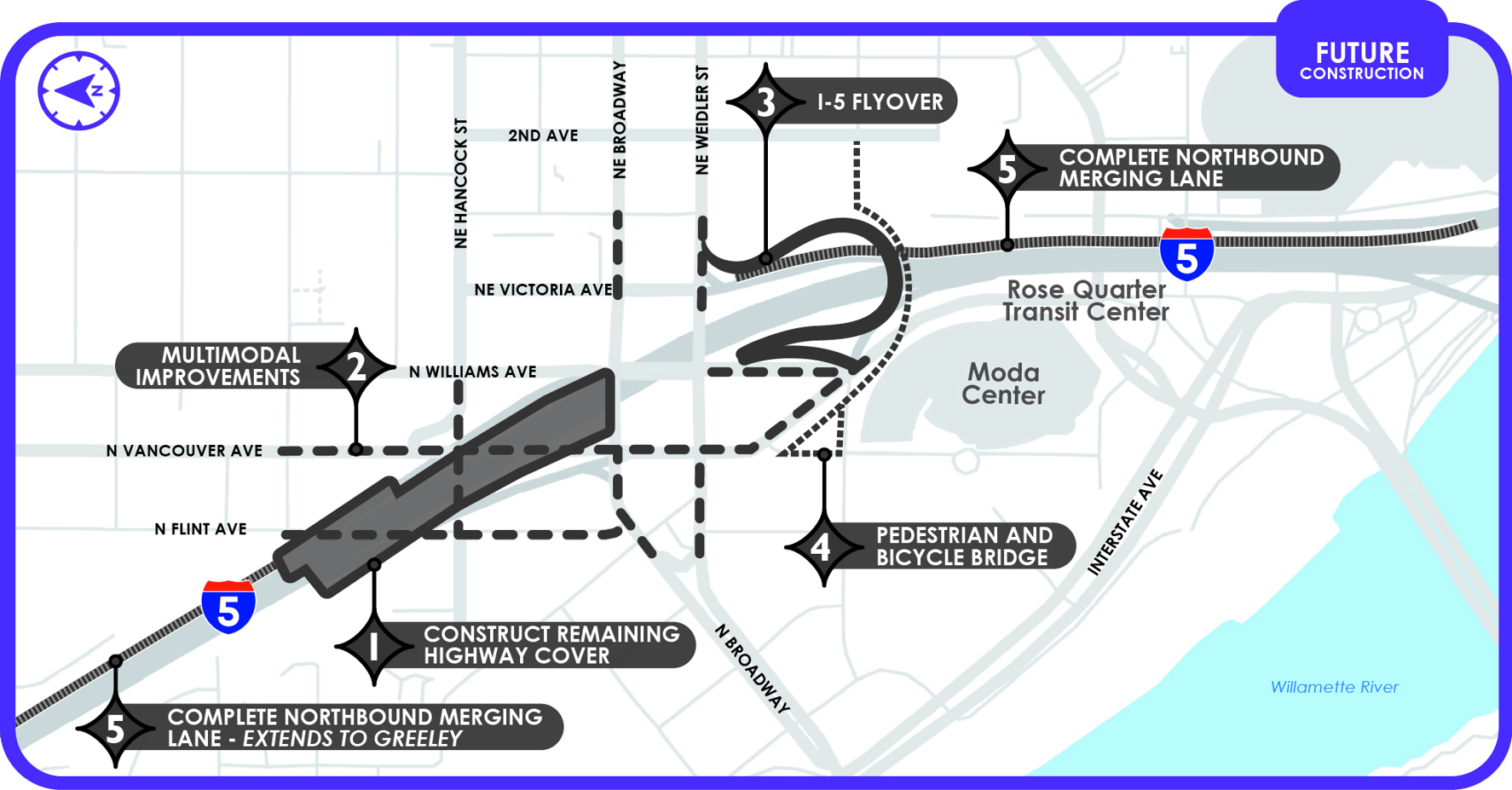
Construction of Phase 1A, 1B, and 1C components will support future construction phases to complete the project in full. ODOT and our partners – City of Portland, Metro, Albina Vision Trust, Oregon Trucking Association, and the Portland Trail Blazers – are committed to completing the project in its entirety. Future project phases are currently unfunded.
Future Phases to begin dependent on funding
How We Are Building It
Construction Manager/General Contractor
A Construction Manager/General Contractor (CM/GC) is a project delivery method where project contracts are released in two phases: first design and later construction. The project owner hires a contractor to provide feedback during the design phase, before construction begins.
A Mini CM/GC method follows the same phasing but is geared to smaller companies. Mini CM/GCs join the project during the design phase and complete work on smaller work contracts within the larger project.
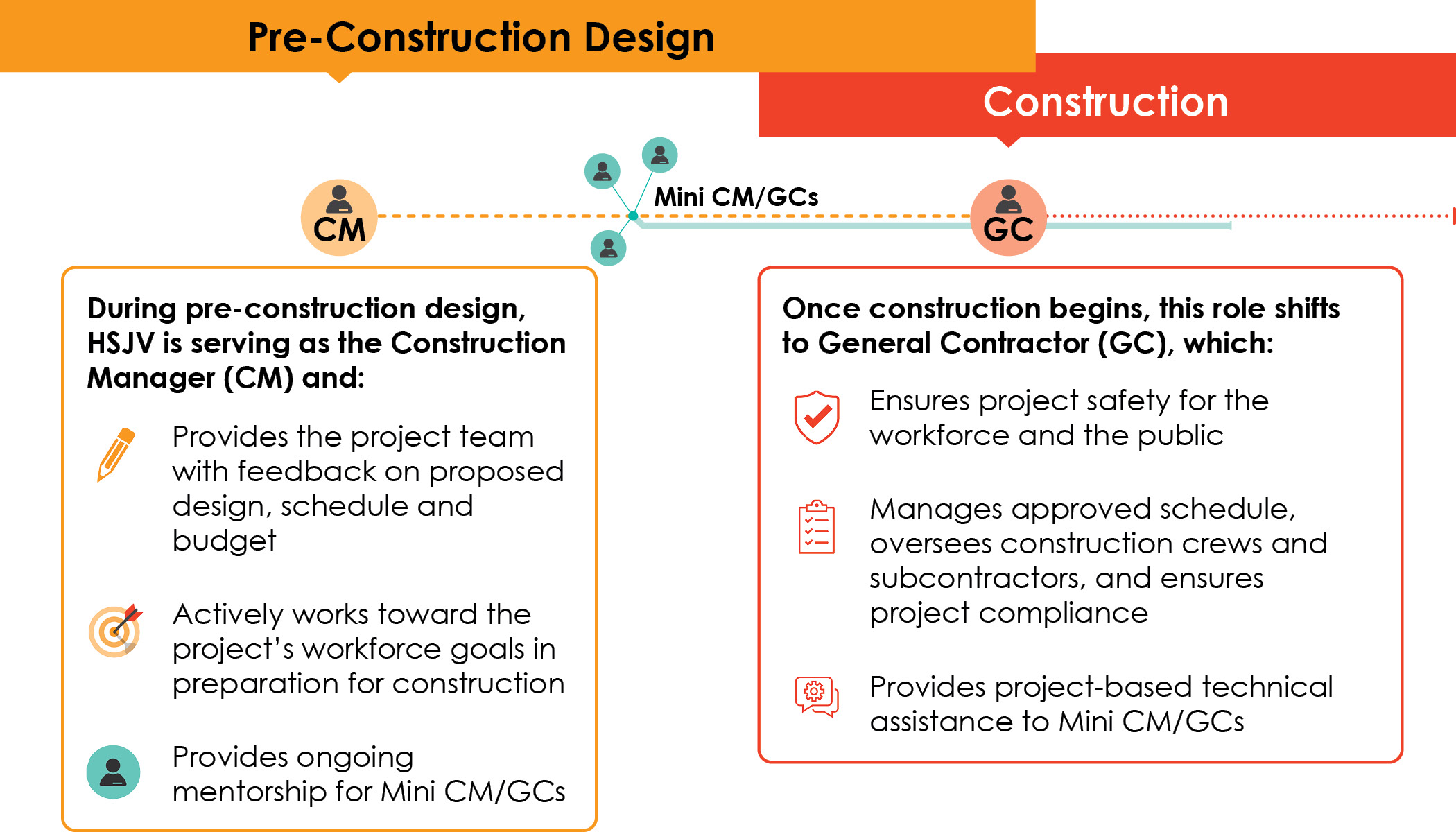

Hamilton/Sundt, a Joint Venture (HSJV), in association with Raimore Construction (one of the largest Black-owned contractors in Oregon), is the project’s Construction Manager/General Contractor (CM/GC).
In 2022, ODOT selected three Mini CM/GCs to complete early work. The Project team, including the project’s CM/GC, also published the Diversity and Subcontracting Plan. To learn more about the project’s commitment to workforce development, visit our Workforce Opportunities page.